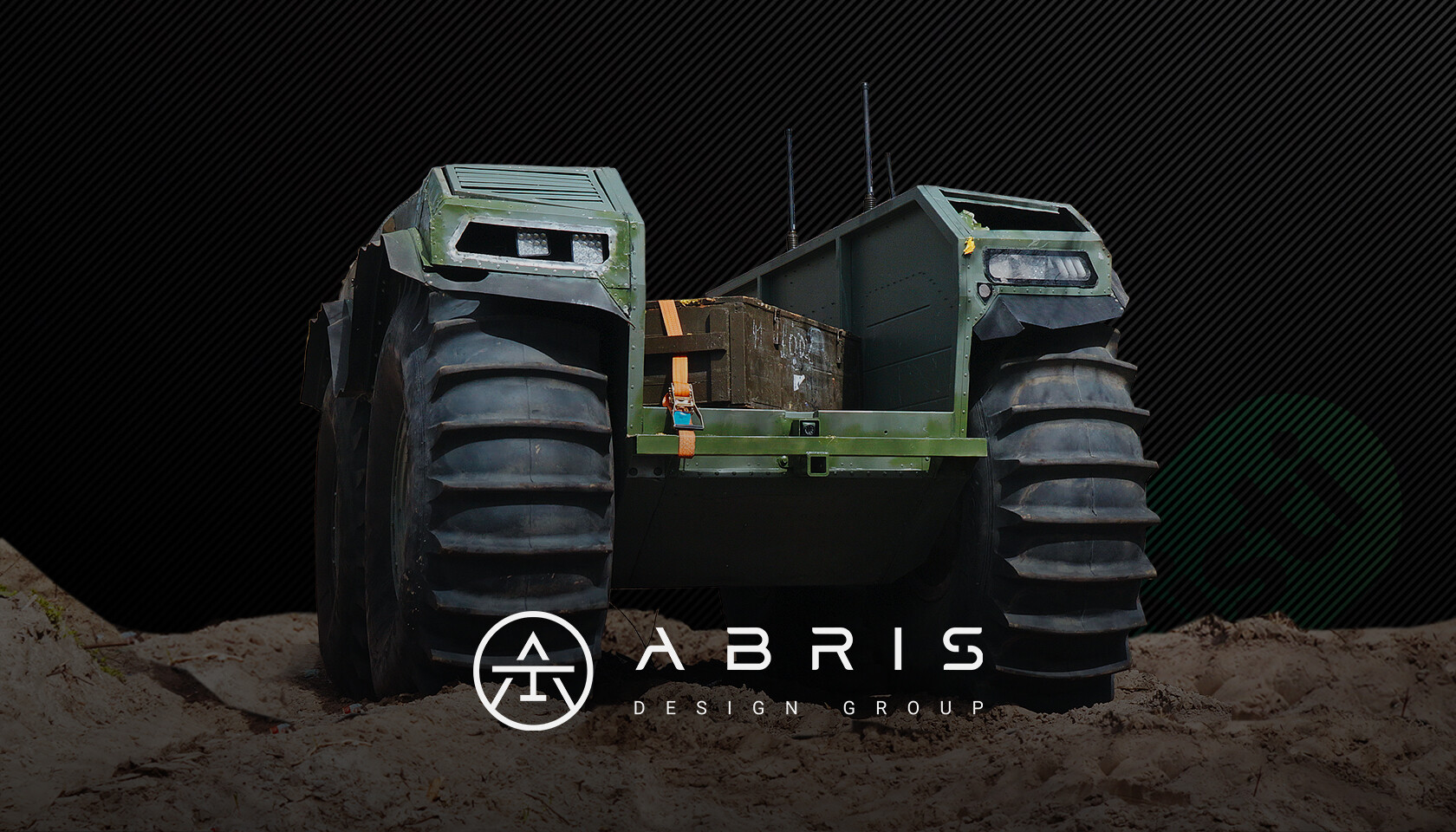
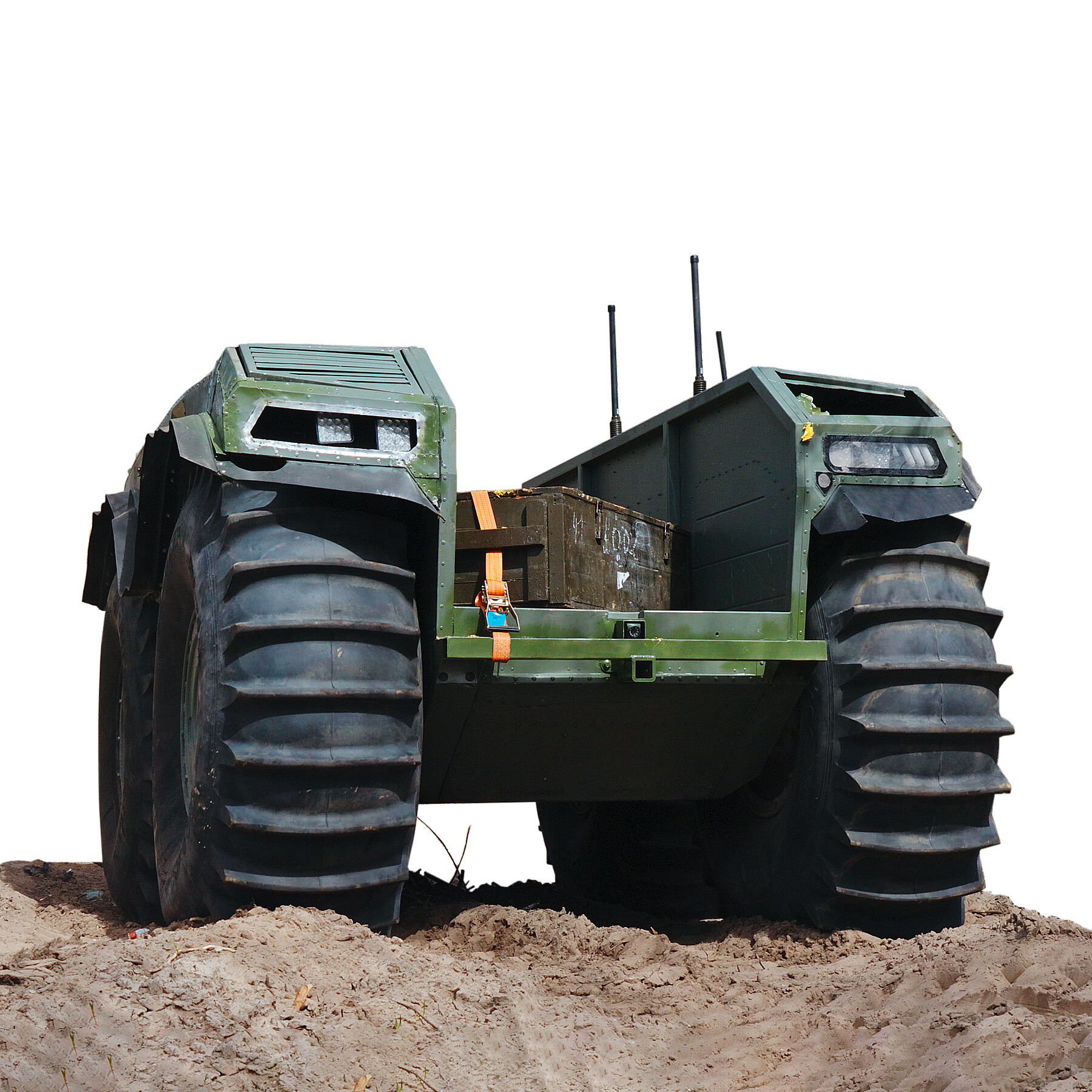

The Abris UNEX unmanned ground vehicle is built for the situations where ordinary platforms simply cannot keep moving. It combines rugged all-terrain mobility with modern remote command options and a fully electric drive system, giving organisations a dependable unmanned capability for harsh environments. Where mud, floodwater, deep snow, loose rubble, steep grades and uneven ground would stall a conventional vehicle, the UNEX UGV is designed to continue operating while still carrying serious payloads. The result is a platform shaped around survivability, range, adaptability and controlled performance, making it highly relevant to defence users, security teams, emergency response operations, and industrial deployments where sending personnel into danger is either costly, risky, or impossible.
What makes the UNEX platform particularly practical is the way it supports multiple control and deployment scenarios without forcing operators into a single method of use. Its navigation and command architecture is built around long-range remote operation as well as autonomous mission execution, allowing teams to run it as a manually controlled vehicle when needed, or as a mission-driven asset when repeatability and reduced operator workload matter most. The vehicle can be controlled by radio out to distances of up to 10 kilometres, and it can also operate over LTE or GSM networks with effectively unlimited range when coverage is available. That combination gives the UNEX UGV the flexibility to work in remote rural environments as well as connected operational theatres, without needing the entire mission to be shaped around one communications constraint. Satellite navigation is supported by interference-resistant CRPA capability, strengthening positioning integrity in environments where GNSS interference, disruption, or degraded conditions would otherwise undermine reliable navigation.

Abris unex ugv unmanned ground vehicle
In the field, a heavy UGV is only as useful as the operator’s awareness of what is happening around it, and the UNEX platform is clearly configured with that reality in mind. It supports a strong sensor and camera approach that prioritises detection, identification and safe navigation across complex terrain. The thermal imaging capability provides a detailed 1280 by 1024 image with a 30 Hz frame rate, making it effective for target detection and observation when visibility is poor or conditions are changing rapidly. Alongside thermal, a Sony 9500L day camera with 40 times optical zoom supports long-range visual identification, which is critical when a remote platform needs to confirm objects, hazards or points of interest at distance. The platform can also integrate up to five additional navigation cameras, enabling 360-degree situational awareness that supports both manual driving and autonomous behaviours. This layered camera configuration is designed to reduce blind spots, reduce the likelihood of navigation errors, and support safe movement when working close to people, vehicles, structures or obstacles.
Autonomy is another defining capability of the UNEX UGV, not as a marketing label, but as an operational tool that can be tailored to real mission needs. A programmable autopilot enables autonomous route following and mission execution, allowing operators to define tasks, behaviours and movement plans that the vehicle can carry out with minimal intervention. This is particularly valuable for repetitive tasks such as resupply runs, route clearance support, or patrol patterns where consistency matters and fatigue can lead to human error. Follow-Me mode expands that flexibility further, allowing the UGV to track and support personnel or vehicles during movement, which can be useful for escort, logistics support, or operating in terrain where keeping formations tight is difficult. The overall effect is that teams can choose the correct balance of manual control and autonomy depending on risk level, terrain complexity and mission pace.

abris unmanned ground vehicle
From a mobility and reliability standpoint, the UNEX UGV is engineered to operate in extreme environments without becoming fragile or overly specialised. Its fully electric drive system delivers controlled power delivery across variable surfaces, while also supporting quieter operation and a reduced thermal signature compared to many combustion-based platforms. The vehicle is rated for operation from minus thirty degrees Celsius through to plus forty degrees Celsius, which supports both severe winter conditions and warmer operational environments. Terrain handling is reinforced by a gradeability of forty degrees and a tilt angle rating of thirty degrees, enabling confident movement on slopes, banks and uneven ground that can be difficult to traverse safely, particularly when the vehicle is carrying substantial payload.
Ground clearance is set at six hundred millimetres, helping the UNEX move through deep ruts, debris, rough terrain and obstacles that would catch or ground many vehicles. Its obstacle capability includes climbing up to one metre high, which is particularly relevant in urban rubble, woodland environments, flood-affected zones, or disaster response situations where the route is uncertain and ground conditions are unpredictable. The platform reaches speeds of up to twenty kilometres per hour, which supports efficient repositioning without pushing stability beyond what is reasonable for an unmanned heavy vehicle. One of the most distinctive aspects of the UNEX mobility design is its large high-buoyancy tyres measuring eighteen hundred by five hundred and eighty by six hundred and thirty-five millimetres, supporting travel through deep mud, snow and water. Rapid tyre inflation, taking around one minute from zero to full pressure, helps the vehicle adapt quickly as terrain demands shift during a mission rather than forcing teams to treat each deployment as a single-condition operation.
The chassis proportions underline that this is a heavy-duty unmanned asset rather than a lightweight scout platform. The UNEX UGV measures three thousand eight hundred and ten millimetres in length, two thousand five hundred millimetres in width, and around one thousand nine hundred millimetres in height on inflated wheels. That stable footprint supports payload integration and on-board modular systems while maintaining control and stability across uneven terrain. Payload capacity reaches up to one thousand seven hundred kilograms, allowing the vehicle to carry equipment, supplies, specialist mission modules, sensors, or support loads without undermining its core mobility purpose. Dry weight is approximately two thousand three hundred kilograms, which reflects a design centred on durability and load-bearing capability while still remaining within practical transport and deployment constraints for its class.
Power and endurance are delivered through a lithium-ion battery system built around field practicality and sustained operation rather than short, high-performance bursts. Total battery capacity is seventy-eight kilowatt hours delivered through dual battery modules, supporting redundancy and resilience. Battery weight is approximately three hundred and forty kilograms, and the platform can sustain up to six hours of continuous operation on a full charge, which is substantial for a heavy, multi-terrain unmanned vehicle. Charging from zero to full is rated at up to six hours, meaning that with structured charging cycles the UNEX can be rotated back into service without unrealistic downtime. The full electric dual-motor system supports precise control, predictable torque and consistent traction behaviour across varied ground conditions, which matters far more in practical deployments than theoretical headline figures.
Where the UNEX UGV becomes particularly compelling is in how it translates these technical capabilities into real operational usefulness. The platform is designed to endure extreme stress, including claims of surviving anti-personnel mine detonation beneath its wheels without critical damage, which highlights a survivability mindset that extends beyond ordinary mobility engineering. Combined with amphibious travel capability and programmable autonomy, the vehicle is suited to high-risk missions as well as disaster response where access is dangerous and time is critical. Depending on configuration, the UNEX can be used for casualty evacuation support, ammunition and supply transport, reconnaissance and observation tasks, or fire support roles, with payload integration allowing the platform to be adapted to mission-specific requirements rather than being locked into a single function.
Industrial and civil applications follow the same logic. In mining, energy infrastructure, flood-affected environments, remote construction sites, or hazardous inspection contexts, the UNEX UGV can reduce the need to place people in high-risk zones while still moving equipment and sensors into the area that needs attention. Its electric drive reduces noise and emissions, which can be beneficial in environmentally sensitive locations and also supports a lower acoustic signature in scenarios where discretion matters. Autonomy and remote operation help reduce manpower requirements, maintain consistent task execution and improve safety by increasing stand-off distance during operations.
As an unmanned ground vehicle supplier, i-Disti focuses on platforms that offer genuine operational credibility rather than superficial capability claims. The Abris UNEX UGV stands out as a robust, mission-flexible platform built for extreme terrain, long endurance and heavy payload transport, supported by advanced navigation, multi-camera awareness and programmable autonomy. For organisations seeking to adopt a capable UGV for demanding environments, the UNEX offers a confident pathway into heavy unmanned mobility with a configuration approach that can be tailored to both military and industrial operational needs.