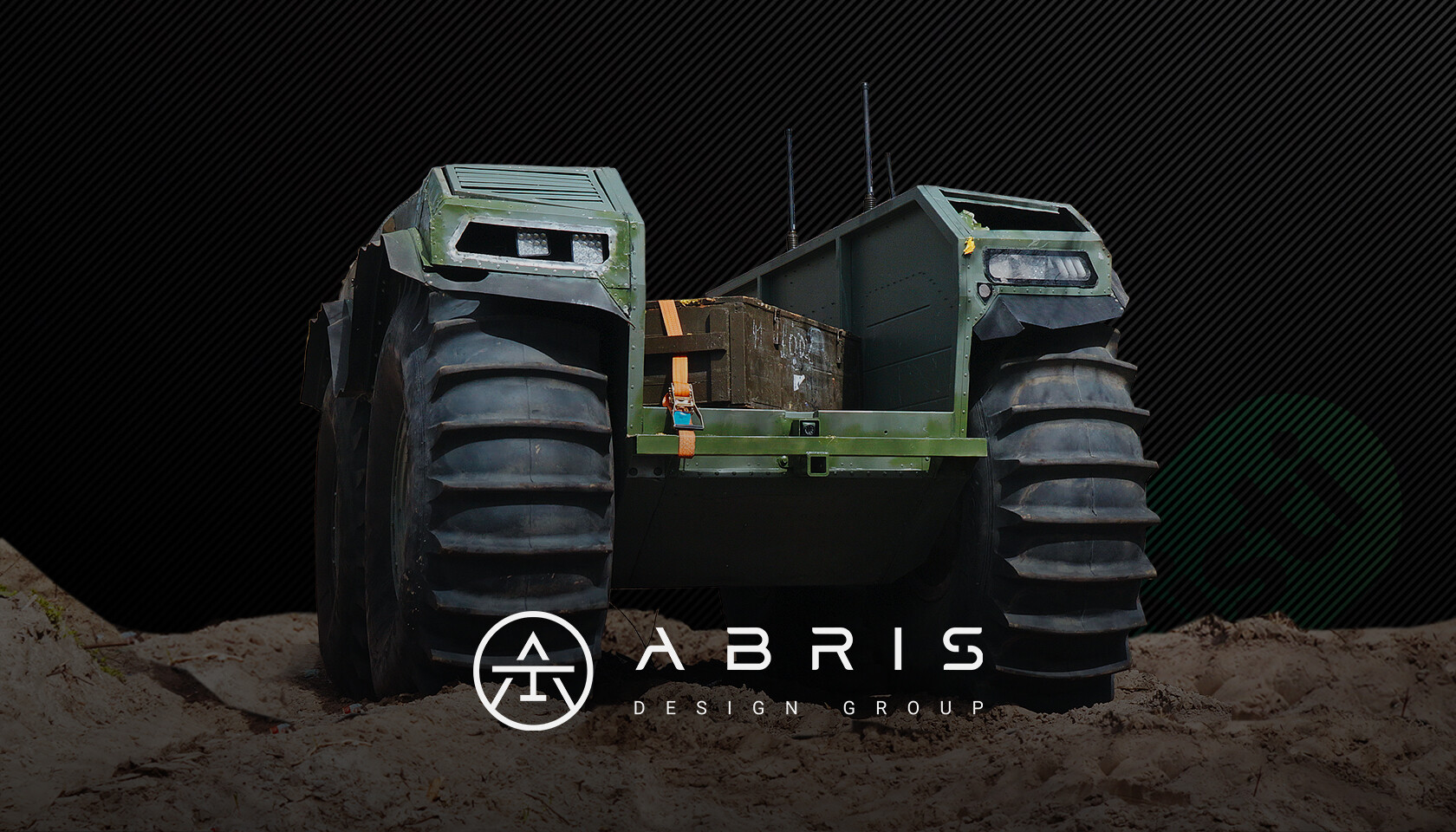
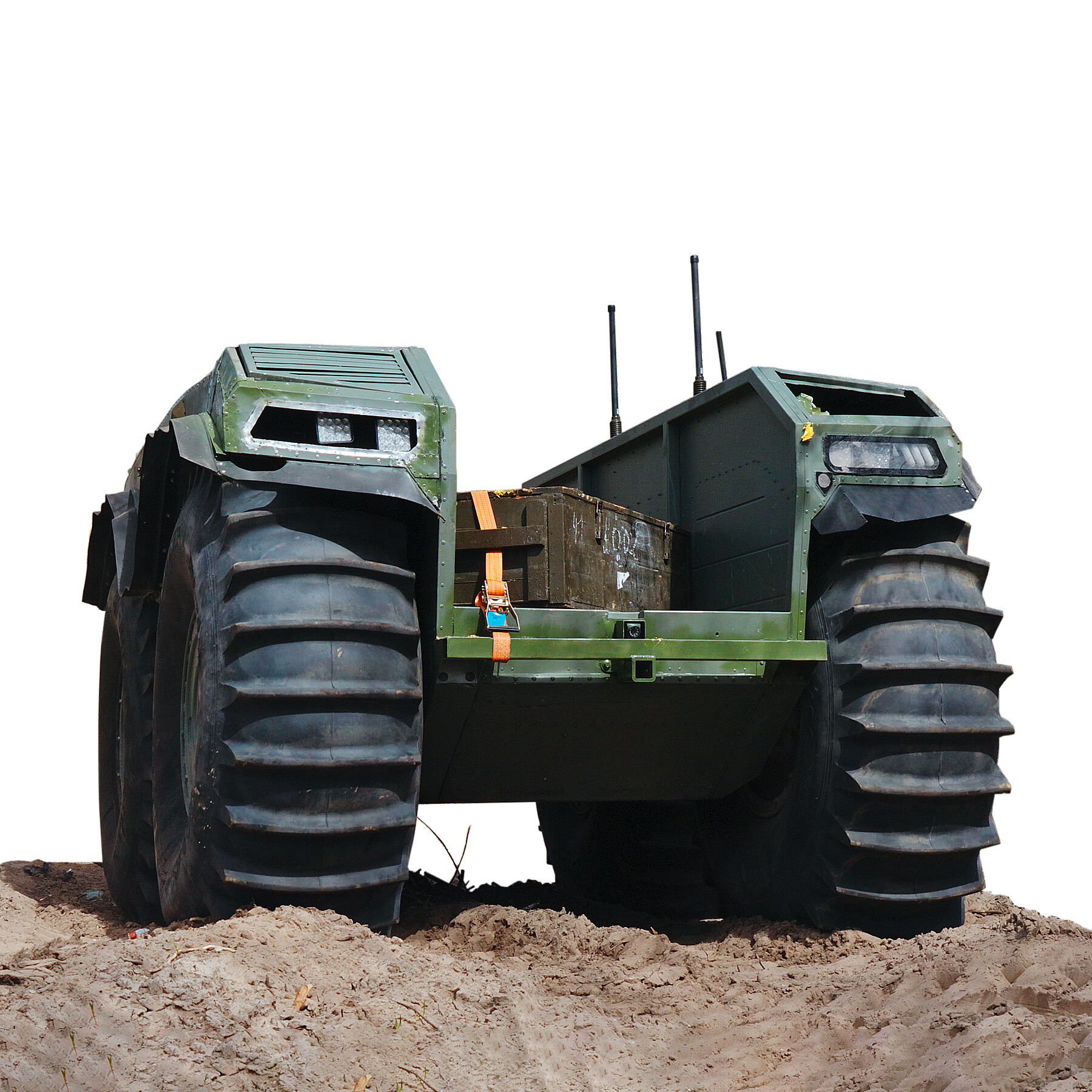

The Abris UNEX unmanned ground vehicle is purpose-built for the kind of terrain and operational stress that disables conventional vehicles. Rather than being optimised for tidy routes and predictable ground conditions, the UNEX UGV is engineered to move through deep mud, standing water, snow, rubble and broken surfaces while still delivering meaningful carrying capacity. With a fully electric drive system and a control stack that supports both remote operation and programmable autonomy, the UNEX is positioned as a serious unmanned asset for defence, security, emergency response and industrial field work where access is dangerous, limited, or time-critical.
One of the strongest advantages of the platform is the way it supports multiple operational control methods without forcing a compromise in deployment strategy. The UNEX can be driven by radio link at distances of up to ten kilometres, enabling robust stand-off operation where line-of-sight control is necessary. When communications infrastructure is available, LTE and GSM connectivity allow the UNEX UGV to be operated far beyond visual range, enabling extended missions across wide operational areas. This dual approach is supported by interference-resistant CRPA satellite navigation, strengthening positioning integrity in environments affected by signal disruption, jamming, or degraded GNSS conditions, where ordinary navigation solutions can become unreliable.

Abris unex ugv unmanned ground vehicle
Operational confidence in an unmanned vehicle depends heavily on the operator’s ability to see and interpret the environment around the platform, and the UNEX addresses this with a sensor configuration aimed at high awareness in difficult conditions. A thermal camera provides a 1280 by 1024 feed with a 30 Hz frame rate, supporting detection of personnel, vehicles and heat signatures when visibility is reduced by darkness, fog, smoke or poor weather. A Sony 9500L day camera with 40 times optical zoom supports detailed visual identification at distance, helping operators confirm obstacles, targets, hazards or route features without closing the stand-off gap. The platform can incorporate up to five additional navigation cameras to provide 360-degree situational awareness, which is particularly valuable when manoeuvring under load, operating near structures, or navigating confined environments where blind spots create risk.
Autonomous operation on the UNEX platform is built as a configurable capability, allowing teams to use autonomy as a practical tool rather than a fixed doctrine. A programmable autopilot supports autonomous navigation and mission execution, enabling route planning and task sequencing that can be repeated reliably with limited operator input. This is especially useful for predictable logistics runs, route rehearsal, repeat patrol patterns, or scenarios where the operator is managing multiple assets and needs a vehicle to complete a defined job consistently. Follow-Me mode adds further flexibility by allowing the UGV to automatically accompany personnel or vehicles, maintaining proximity and pace while reducing the need for constant manual corrections in complex terrain.

abris unmanned ground vehicle
Across harsh terrain, the UNEX UGV is configured to deliver stable mobility rather than fragile speed. The fully electric drive provides controllable power delivery across mixed surfaces while maintaining low noise output and a reduced thermal signature, which can be advantageous in both tactical and sensitive industrial environments. The platform is rated for operating temperatures between minus thirty degrees Celsius and plus forty degrees Celsius, supporting deployment in winter conditions, highland environments and exposed hot-weather theatres. With a gradeability rating of forty degrees and a maximum tilt angle of thirty degrees, the UNEX is capable of managing steep inclines, embankments and uneven ground where conventional wheeled vehicles would struggle for traction or stability.
Mobility is reinforced by a high ground clearance of six hundred millimetres, allowing the UNEX to move over deep ruts, debris and rough ground without snagging or grounding. Its obstacle capability includes climbing up to one metre high, which is particularly relevant in disaster environments, rubble zones and off-road terrain where the route is partially blocked or undefined. A maximum speed of up to twenty kilometres per hour enables efficient repositioning while maintaining the stability appropriate for a heavy unmanned platform. The UNEX’s large high-buoyancy tyres measuring eighteen hundred by five hundred and eighty by six hundred and thirty-five millimetres support travel through water, mud and snow, giving the platform amphibious mobility without requiring complex additional equipment. Rapid tyre inflation, taking around one minute from zero to full pressure, allows the vehicle to respond quickly to changing surface requirements during a mission.
The platform’s size and carrying capacity make it particularly well suited to heavy support roles. The UNEX UGV has an overall length of three thousand eight hundred and ten millimetres, a width of two thousand five hundred millimetres and a height of around one thousand nine hundred millimetres on inflated wheels. This stable footprint supports payload integration and helps maintain balance when transporting heavy loads across uneven surfaces. Payload capacity reaches up to one thousand seven hundred kilograms, enabling the UNEX to carry supplies, equipment, mission modules or specialist systems without undermining its mobility purpose. Dry weight is approximately two thousand three hundred kilograms, reflecting a chassis designed for durability and load-bearing capability while remaining within practical deployment limits for its class.
Endurance is delivered by a lithium-ion battery system designed for sustained operations rather than short-range usage. Total battery capacity is seventy-eight kilowatt hours across dual battery modules, supporting redundancy and resilience in field conditions. Battery weight is approximately three hundred and forty kilograms, and the platform can achieve up to six hours of continuous operation on a full charge, supporting extended missions without frequent recovery cycles. Charging from zero to full is rated at up to six hours, enabling predictable turnaround and routine operational planning. A full electric dual-motor configuration supports consistent torque delivery, fine control at low speeds and stable traction behaviour under load across varied surfaces.
In practical application, the UNEX UGV is designed for the realities of contested or hazardous environments. The platform is described as capable of withstanding anti-personnel mine detonation beneath its wheels without critical damage, reflecting a survivability mindset aimed at keeping the vehicle operational when conditions are severe. Combined with amphibious capability and autonomous navigation, this supports use in high-risk military scenarios as well as civil response operations where debris, flooding and unstable terrain are common. Depending on configuration, the UNEX can be adapted for casualty evacuation support, ammunition and supply transport, reconnaissance tasks or fire support roles, with modular payload integration allowing mission tailoring rather than forcing the user into a single use-case.
Industrial operations benefit from the same fundamentals. In mining, energy infrastructure, flood response, remote construction and hazardous inspection work, the UNEX can reduce the need to place people in risky zones while still delivering tools, sensors and equipment into the area of interest. Electric drive can reduce emissions and noise, which matters in environmentally sensitive locations and in operational environments where sound and heat output are undesirable. Remote operation and autonomy reduce manpower requirements, support consistent task execution and allow teams to maintain stand-off distance while still achieving operational objectives.
As a specialist unmanned ground vehicle supplier, i-Disti focuses on platforms that offer real-world utility, credible performance and flexible configuration paths. The Abris UNEX UGV stands out as a heavy-capacity, long-endurance, extreme-terrain platform that combines modern navigation, multi-camera situational awareness and autonomous capability with a fully electric drivetrain. For organisations looking to deploy an unmanned ground vehicle that can handle severe terrain while carrying serious payloads, the UNEX represents a robust and adaptable solution for modern field operations.