

For over a century, the evolution of warfare has been defined by advances in mobility. From horses to tanks, from helicopters to drones — each leap forward has reshaped tactics, logistics, and survivability. Yet one area of mobility remains in the midst of rapid transformation: the ground itself. As militaries around the world move toward automation and remote systems, unmanned ground vehicles (UGVs) are quietly becoming the next strategic asset in modern defence.
The principle behind UGVs is simple — keep soldiers out of harm’s way while maintaining operational capability on the ground. Whether used for reconnaissance, logistics, combat support, or casualty evacuation, these autonomous or remotely operated platforms are designed to go where humans can’t or shouldn’t. They’re the bridge between the reach of unmanned aerial vehicles and the resilience of traditional armoured systems — but with a fraction of the risk.
Today’s combat environments demand mobility in unpredictable, hostile, and often urbanised terrains. Traditional vehicles — heavy, crewed, and fuel-dependent — are not always suitable for these fast-moving, high-risk operations. That’s where the new generation of UGVs comes in. Quiet, electric, amphibious, and modular by design, they offer tactical flexibility and precision that older systems simply can’t match. From carrying ammunition and supplies across mined or flooded terrain, to extracting injured personnel under fire, UGVs are proving that autonomy is not just a luxury — it’s a necessity.
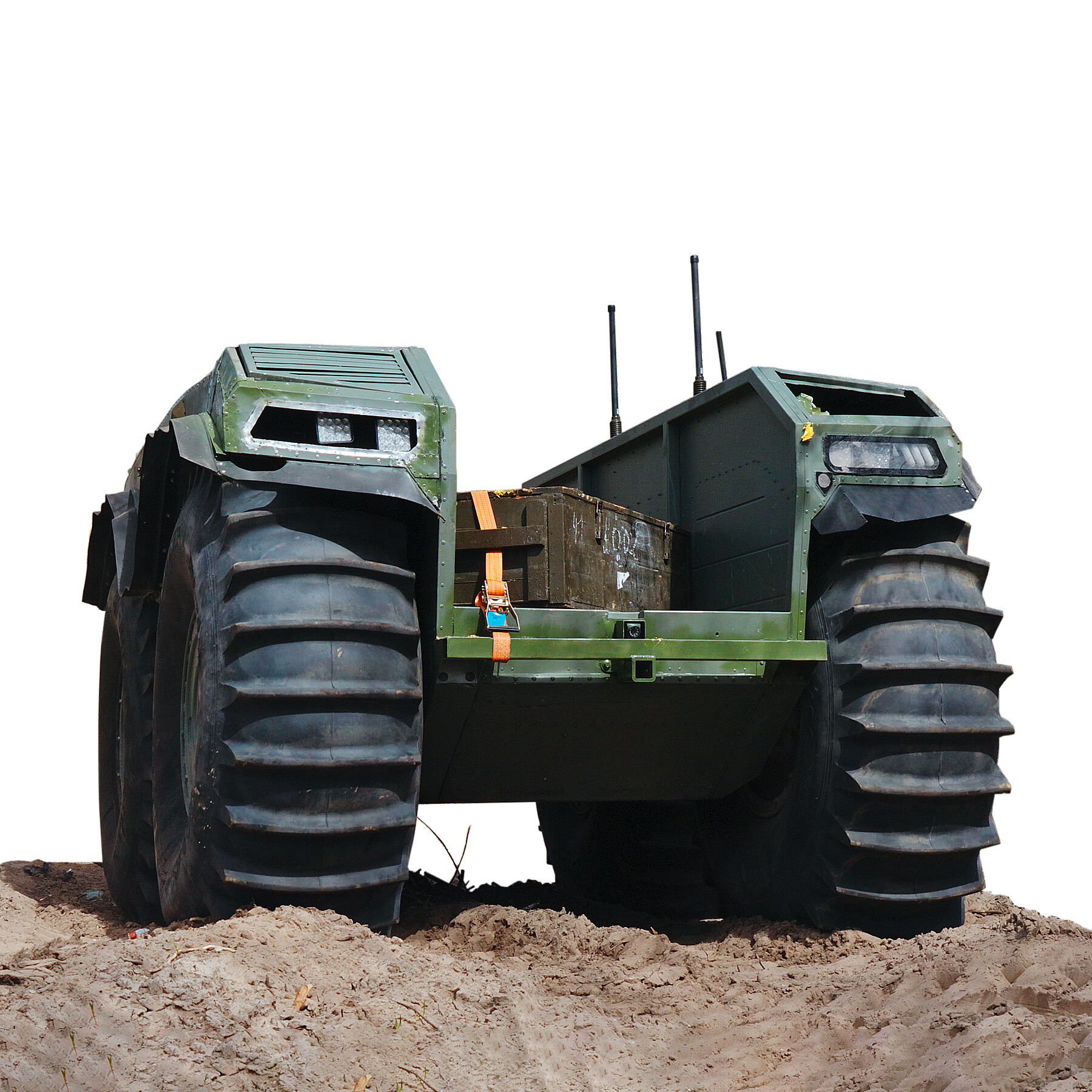
Among the latest innovations leading this shift is the Abris UNEX UGV, an electric, amphibious platform designed specifically for demanding operational environments. Unlike many prototypes still in development, the UNEX is a fully capable system — robust, versatile, and field-ready. Its large buoyant tires and waterproof chassis allow it to operate seamlessly across mud, sand, rubble, and even water. The design distributes weight evenly, giving it the rare ability to traverse minefields without triggering explosives — a critical advantage in asymmetric warfare and post-conflict recovery zones.
The UNEX’s electric powertrain is another defining feature. It offers instant torque and low acoustic emissions, allowing for near-silent operation in reconnaissance or stealth missions. Its remote-control and semi-autonomous navigation systems enable safe operation from a distance, protecting personnel from exposure to enemy fire or hazardous materials. More importantly, it can be reconfigured quickly in the field — carrying supplies one moment, medical equipment the next. This flexibility makes it not just a vehicle, but a mobile asset adaptable to almost any tactical scenario.
abris unmanned ground vehicles
In the broader defence landscape, the rise of platforms like the UNEX reflects a fundamental shift in how armed forces think about presence and persistence. The battlefield is becoming increasingly data-driven, interconnected, and robotic — where situational awareness and rapid response matter more than brute force. UGVs fit perfectly into this doctrine. They can operate alongside troops or drones, acting as forward scouts, logistic partners, or mobile sensor hubs — extending a unit’s reach while reducing its risk profile.
The implications go far beyond combat. Humanitarian missions, disaster response, and border patrol operations all stand to benefit from these same technologies. When floods, radiation, or chemical spills make human entry impossible, an amphibious, electric UGV like the Abris UNEX can go in first — collecting data, delivering supplies, or even saving lives. In that sense, its military origins feed directly into civilian resilience, creating technology that serves both protection and preservation.
As nations invest heavily in automation, robotics, and AI-driven defence systems, the unmanned ground vehicle is no longer a speculative concept. It’s the next step in operational evolution — and platforms like the Abris UNEX UGV show that this future isn’t distant. It’s already here, and it’s built to go where no one else can.
Learn more about the Abris UNEX UGV here


