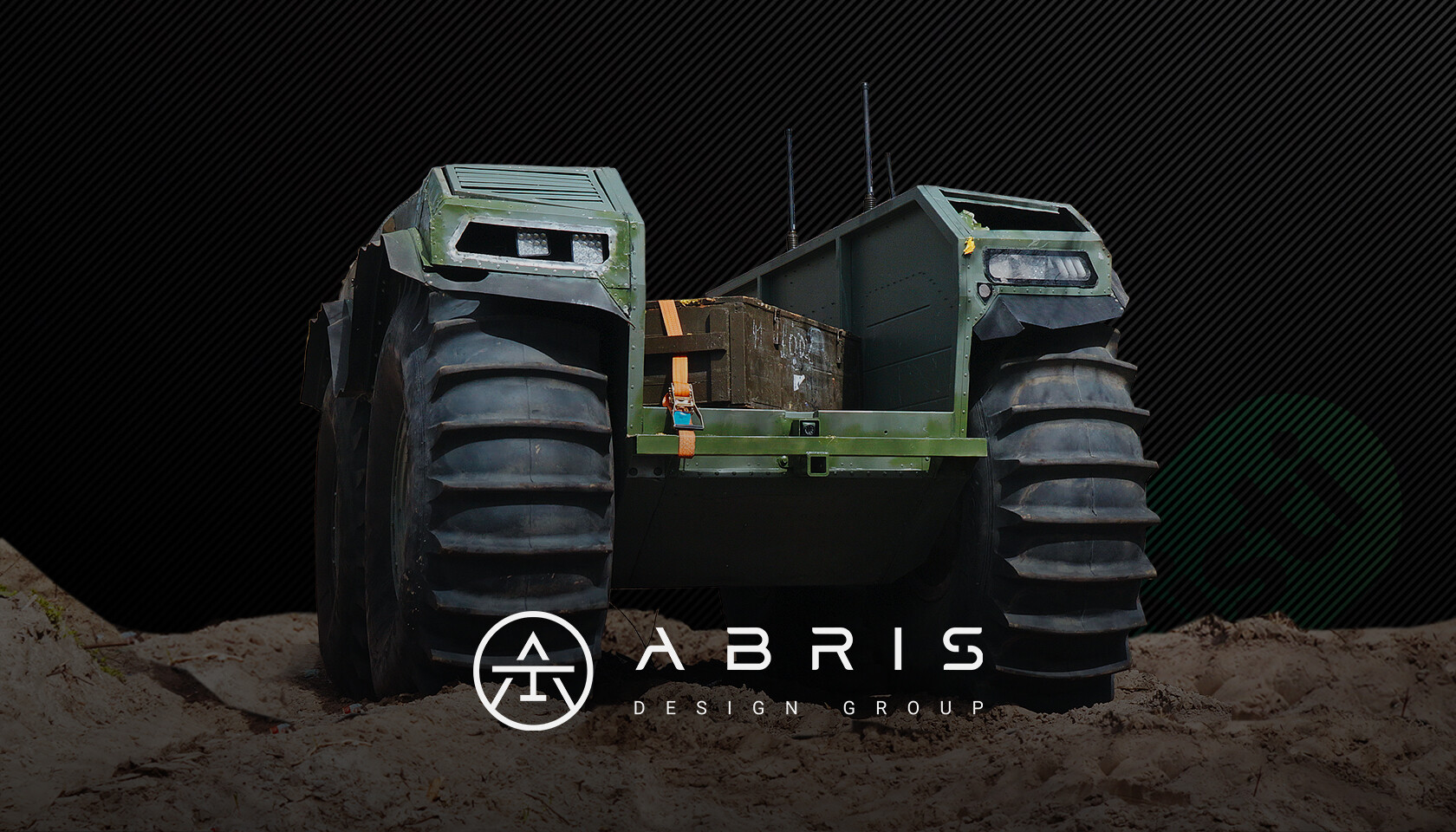
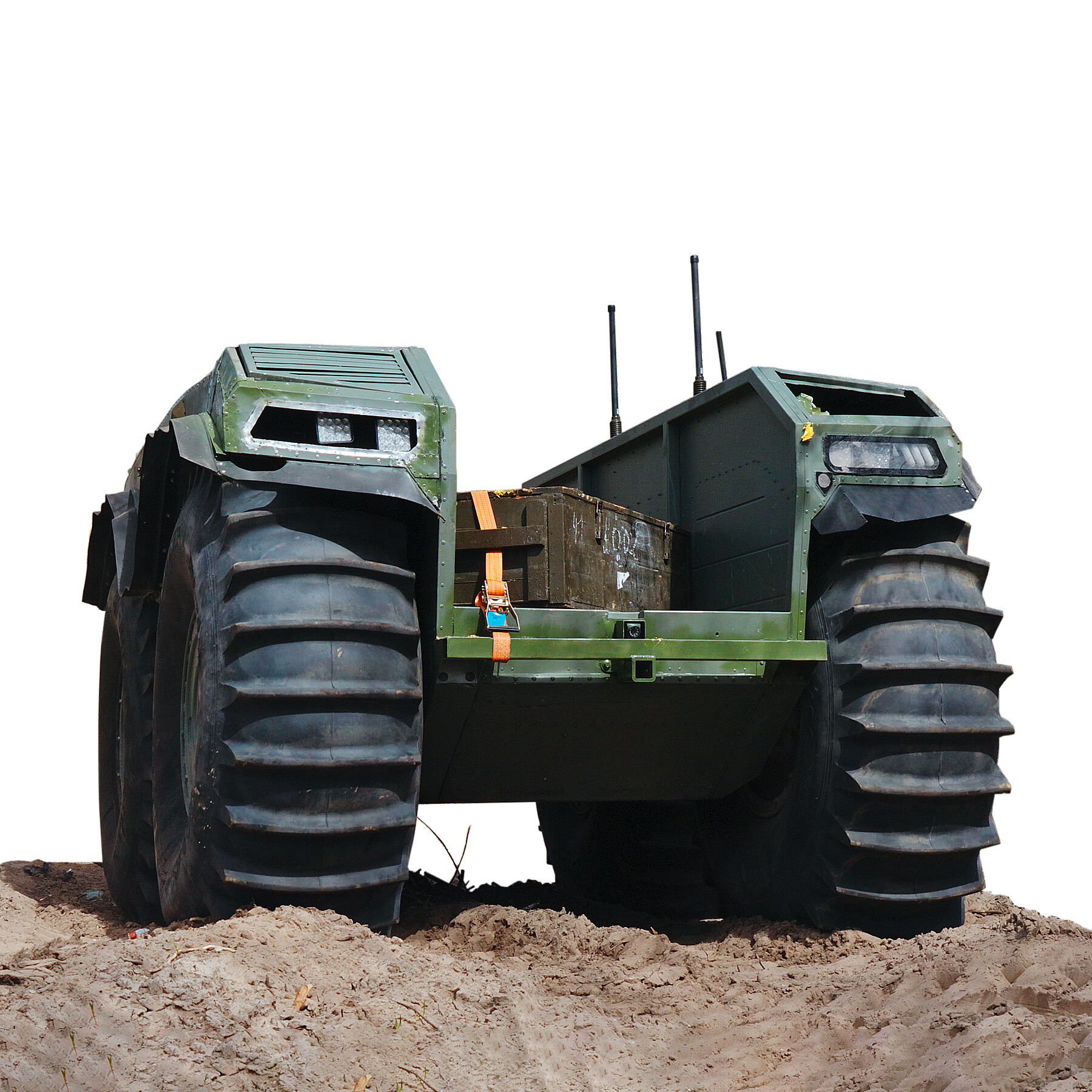

The Abris UNEX unmanned ground vehicle has been developed specifically for operations where conventional vehicles reach their limits. Built as a heavy-duty unmanned platform, it combines extreme multi-terrain mobility with modern autonomous control systems and a fully electric drivetrain. The UNEX UGV is intended to keep operating in environments dominated by deep mud, standing water, snow, rubble and severe ground disruption, all while carrying meaningful payloads. Its overall design places durability, operational endurance and adaptability ahead of cosmetic performance figures, making it relevant to defence, security, disaster response and industrial users who need dependable access without exposing personnel to unnecessary risk.
The operational flexibility of the UNEX platform is driven by a control architecture that supports both direct remote driving and structured autonomous tasking. Long-range radio control enables operation at distances of up to ten kilometres, while LTE and GSM connectivity allow the vehicle to be operated far beyond line-of-sight where network infrastructure exists. This combination allows the UNEX UGV to be deployed across isolated rural terrain, disaster zones and connected operational areas without forcing compromises in mission planning. Positioning is supported by interference-resistant CRPA satellite navigation, helping to maintain reliable location data in environments where GNSS disruption, signal interference or degraded coverage would otherwise reduce navigation confidence.

Abris unex ugv unmanned ground vehicle
Awareness and visibility are central to the UNEX UGV’s operational effectiveness, particularly when operating remotely in complex or unpredictable terrain. The platform supports a layered sensor approach that gives operators a detailed understanding of the surrounding environment. A high-resolution thermal imaging system provides a 1280 by 1024 image at a 30 Hz refresh rate, supporting reliable detection of people, vehicles and heat sources in darkness, smoke, fog or poor weather. This is complemented by a Sony 9500L daylight camera offering 40 times optical zoom, allowing precise visual identification at distance. Up to five additional navigation cameras can be integrated to provide full 360-degree situational awareness, supporting safe manoeuvring during both manual control and autonomous movement while reducing blind spots and operator workload.
Autonomous capability within the UNEX platform is designed as a practical tool rather than a fixed operating mode. A programmable autopilot allows missions to be planned in advance, with defined routes, behaviours and task execution that can be repeated reliably with minimal operator input. This supports logistics runs, patrol routes and routine operational tasks where consistency is critical. A Follow-Me function further extends this capability by enabling the vehicle to autonomously accompany personnel or vehicles, maintaining position and pace without constant manual correction. These features allow teams to select the appropriate balance between autonomy and direct control depending on terrain complexity, risk level and operational tempo.

abris unmanned ground vehicle
In terms of physical performance, the UNEX UGV is engineered to cope with extreme environmental stress without sacrificing controllability. Its fully electric drive system delivers smooth, predictable power across varied surfaces while maintaining a low acoustic and thermal signature. The platform is rated to operate from minus thirty degrees Celsius to plus forty degrees Celsius, supporting deployment in cold-weather regions as well as hot, exposed environments. A gradeability rating of forty degrees and a maximum tilt angle of thirty degrees allow the vehicle to traverse steep slopes, embankments and uneven ground that would be impractical or unsafe for many traditional vehicles.
Mobility is reinforced by a ground clearance of six hundred millimetres, enabling the UNEX to pass over debris, deep ruts and rough terrain without grounding. The vehicle can climb obstacles up to one metre in height, which is particularly valuable in urban damage zones, forestry environments or disaster areas where the route ahead is uncertain. A top speed of up to twenty kilometres per hour provides efficient repositioning while maintaining stability appropriate for an unmanned heavy platform. Large high-buoyancy tyres measuring eighteen hundred by five hundred and eighty by six hundred and thirty-five millimetres support travel through mud, snow and water, giving the UNEX true amphibious capability without additional equipment. Rapid tyre inflation, taking around one minute from zero to full pressure, allows the vehicle to adapt quickly as surface conditions change during a mission.
The proportions of the UNEX UGV reflect its role as a load-carrying unmanned vehicle rather than a lightweight scout. With an overall length of three thousand eight hundred and ten millimetres, a width of two thousand five hundred millimetres and a height of approximately one thousand nine hundred millimetres on inflated wheels, the chassis provides a stable platform for modular payload integration. Payload capacity reaches up to one thousand seven hundred kilograms, allowing the vehicle to transport equipment, supplies or mission-specific modules without compromising mobility. A dry weight of around two thousand three hundred kilograms balances structural strength with practical transport and deployment considerations.
Electrical power is supplied by a high-capacity lithium-ion battery system designed for sustained field use. Total battery capacity is seventy-eight kilowatt hours delivered through dual battery modules, providing redundancy and resilience during extended operations. Battery weight is approximately three hundred and forty kilograms, and the platform is capable of up to six hours of continuous operation on a full charge. Charging from zero to full takes up to six hours, allowing the vehicle to be rotated back into service with predictable downtime. A full electric dual-motor configuration ensures consistent torque delivery and precise control across varying terrain types, which is critical for safe unmanned operation under load.
The UNEX UGV’s value becomes most apparent when considering real-world mission demands rather than isolated specifications. The platform is engineered to tolerate extreme stress, including the ability to withstand anti-personnel mine detonation beneath its wheels without critical damage, highlighting a design focus on survivability. Combined with amphibious movement and autonomous navigation, this resilience makes the UNEX suitable for high-risk military missions as well as humanitarian and disaster response roles. Depending on configuration, it can be adapted for casualty evacuation support, logistics and resupply, reconnaissance tasks or fire support roles, with modular payload integration allowing the vehicle to evolve alongside mission requirements.
For industrial and civil operators, the same attributes translate into safer and more efficient field operations. In mining, energy infrastructure, flood response, remote construction and hazardous inspection environments, the UNEX can reduce the need for personnel to enter dangerous areas while still delivering equipment and sensor systems where they are needed. Its electric drivetrain supports lower emissions and reduced noise, which is advantageous in environmentally sensitive locations and confined operational areas. Remote operation and autonomy reduce manpower demands and help maintain consistent task execution over long periods.
As a specialist unmanned ground vehicle supplier, i-Disti prioritises platforms that demonstrate genuine operational capability rather than theoretical performance. The Abris UNEX UGV stands as a robust, field-ready solution that combines heavy payload capacity, long endurance and extreme terrain mobility with advanced navigation, situational awareness and autonomous control. For organisations looking to integrate a serious unmanned ground platform into demanding operational environments, the UNEX offers a credible and adaptable foundation for modern unmanned mobility.